🍪 Cookies & Privacy

This website uses cookies to provide services in accordance with the Cookie Policy. You can specify the conditions for storing or accessing cookies in your browser.

Back to Knowledge Base

All-on-4 vs All-on-6: Which Full Arch Solution Fits You? (Comparison 2026)

All-on-4 vs All-on-6: Which Full Arch Solution Fits You? (Comparison 2026)
2026-05-25

Introduction — What Are All-on-4 and All-on-6 Concepts?


If you need to restore a complete jaw arch with dental prostheses (upper or lower jaw completely edentulous), you face an important decision: how many implants do you need? The two dominant modern concepts are All-on-4 and All-on-6.


Both procedures offer you a fixed full bridge on a small number of implants — no removable denture, no loss of taste sensation, no loss of chewing power. Both are often combined with immediate loading (temporary bridge on the day of surgery).


Which concept is right for you depends on your bone quality, budget, lifestyle factors, and individual risk profile. This article is a structured comparison for decision support — based on scientific evidence and our clinical practice in Mikrostomart Opole.


All-on-4 — The Original Concept


The All-on-4 concept was developed in the early 2000s by Dr Paulo Maló (Lisbon) and published in a pioneering study in 2003. The idea: four strategically positioned implants are sufficient to anchor a complete fixed bridge (12-14 teeth) stably.


Characteristic features:


  • 2 anterior implants — placed straight, in the dense bone below the incisors
  • 2 distal implants — placed at an angle of 30-45° backwards, to bypass the maxillary sinus (upper jaw) or the nerve canal (lower jaw)
  • Immediate loading with temporary bridge on the day of surgery
  • Consolidation phase 3-4 months, then final bridge

  • The key advantage: angled placement bypasses anatomical obstacles — for most patients, bone grafting is not necessary. This dramatically shortens total treatment time (from 9-14 months to 4-6 months) and lowers costs.


    All-on-6 — The More Conservative Variant


    The All-on-6 concept uses six implants instead of four. It was developed, among others, by Dr Carl Misch (USA) as an alternative strategy for demanding cases.


    Characteristic features:


  • 6 implants distributed across the entire jaw arch
  • Mostly straight placement (no extreme angulation required)
  • More implants = better load distribution — each implant carries less mechanical load
  • Extended indication — also for patients with bruxism, weak bone quality, or previous implant losses
  • Bone grafting more frequently necessary — for severely resorbed jaws, often sinus lift or GBR is required first

  • Key Differences Overview


    Number of Implants


  • All-on-4: 4 implants (2 anterior straight + 2 distal angled)
  • All-on-6: 6 implants (distributed, mostly straight)

  • Angled vs. Straight Placement


  • All-on-4: distal implants strongly angled (30-45°) — bypasses anatomical obstacles
  • All-on-6: predominantly straight placement — biomechanically more conservative

  • Load Distribution per Implant


  • All-on-4: each implant carries approximately 25% of chewing load
  • All-on-6: each implant carries approximately 17% — less individual load, better for bruxism

  • Need for Bone Grafting


  • All-on-4: usually not necessary (angled placement bypasses sinus lift/GBR)
  • All-on-6: often necessary for resorbed jaws — extends treatment time

  • Treatment Duration


  • All-on-4: 4-6 months (without grafting), often immediate loading
  • All-on-6: 6-9 months without grafting, 9-14 months with grafting

  • Costs


  • All-on-4 with immediate loading: 30,000-40,000 PLN (~£6,000-8,000 / €7,000-9,300)
  • All-on-6 with immediate loading: 45,000-55,000 PLN (~£9,000-11,000 / €10,500-12,800)
  • Cost difference: approximately 15,000 PLN (~£3,000)

  • Success Rate (10-year studies)


  • All-on-4 (Maló 2011, 2019): 96-98% implant survival, 99.2% prosthetic survival
  • All-on-6 (Misch protocols): 97-99% — marginally more security per implant with higher implant count, but statistically converging

  • Maintenance and Repair Susceptibility


  • All-on-4: fewer implants = fewer potential complication sites
  • All-on-6: if one implant fails, the bridge can often continue to function (more reserve)

  • When All-on-4 Is the Right Choice


    The All-on-4 concept is the right option if the following factors apply to you:


  • Severely resorbed jaw bone — you want to avoid bone grafting
  • Limited budget — All-on-4 is approximately 30% cheaper than All-on-6
  • Fast treatment desired — you want to eat and speak normally as quickly as possible
  • No severe bruxism — you don't press or grind your teeth heavily
  • Good systemic health — no uncontrolled diabetes, no heavy smoking
  • Simpler oral hygiene preferred — 4 implants are easier to clean than 6

  • Most of our patients from the UK with complete upper jaw edentulism benefit from the All-on-4 concept — shorter treatment time (often 2 visits instead of 4) means fewer trips, fewer hotel stays, fewer holiday days used.


    When All-on-6 Is the Right Choice


    The All-on-6 concept is the right option in the following situations:


  • Sufficient bone volume present (or bone grafting no obstacle)
  • Severe bruxism or grinding — more implants distribute excessive forces
  • Previous implant losses — you want security reserve
  • Higher budget available — 15,000 PLN (~£3,000) surcharge for the Premium variant
  • Longer life expectancy of the dental restoration prioritised — for patients under 60 years with healthy lifestyle
  • Posterior stability important — for patients who chew strongly with back teeth

  • All-on-6 is the "more conservative" choice in the positive sense — more reserves for longer restoration lifespan.


    Hybrid: All-on-4 plus 2 (Compromise Option)


    A less well-known but clinically valuable variant is All-on-4 plus 2: you start with the classic All-on-4 concept and supplement it with two additional anterior implants. The result: 6 distributed implants, but with the immediate loading logic of the All-on-4 approach.


    Indication:


  • Patients between All-on-4 and All-on-6 — want security reserve, but without the effort of complete bone grafting
  • Phased treatment possible — first All-on-4 with immediate loading, later supplementary 2 implants
  • Costs between the two concepts: approximately 37,000-47,000 PLN (~£7,400-9,400 / €8,600-11,000)

  • Scientific Evidence — Long-Term Studies


    The comparative data for both concepts is extensively documented:


  • Maló et al. 2003 — original All-on-4 study on 44 patients, 100% implant survival at 1 year
  • Maló et al. 2011 — 5-year study on 245 patients: 97% implant survival, 99% prosthetic survival
  • Maló et al. 201918-year follow-up of original patients: 94.8% implant survival, 99.2% prosthetic survival
  • Soto-Penaloza et al. 2017 — systematic review of All-on-4: 99.2% prosthetic survival across all studies
  • Eliasson et al. 2010 — Six-implant concepts: 98.7% success over 5 years
  • ITI Treatment Guide 2019 — both concepts recognised as evidence-based

  • Key lesson: With correctly indicated application, both concepts are equally successful. The decision should not primarily be based on "more is better", but on individual clinical factors.


    Marcin Nowosielski — Decision Recommendation


    Dr Marcin Nowosielski's decision algorithm is based on CBCT diagnostics and a thorough medical history:


  • Step 1 — CBCT assessment: bone volume, density, anatomical obstacles (sinus, nerve canal)
  • Step 2 — Lifestyle history: bruxism, smoking habits, systemic diseases, compliance
  • Step 3 — Budget reality: what fits your financial framework without compromising quality?
  • Step 4 — Life expectancy factor: for patients under 55 years, tendency toward All-on-6 (longer lifespan); for patients over 65, often All-on-4 (faster treatment)
  • Step 5 — Patient preference: you have the final say — we present both options clearly with pros and cons

  • Marcin's Clinical Protocol:


  • Premium implants exclusively — Straumann BLT, Nobel Replace CC, Astra Tech EV (same brands as in top UK private clinics)
  • Osstell ISQ measurement intraoperatively before immediate loading decision
  • PRF in every socket — accelerates healing (Marcin's LA&HA specialty area)
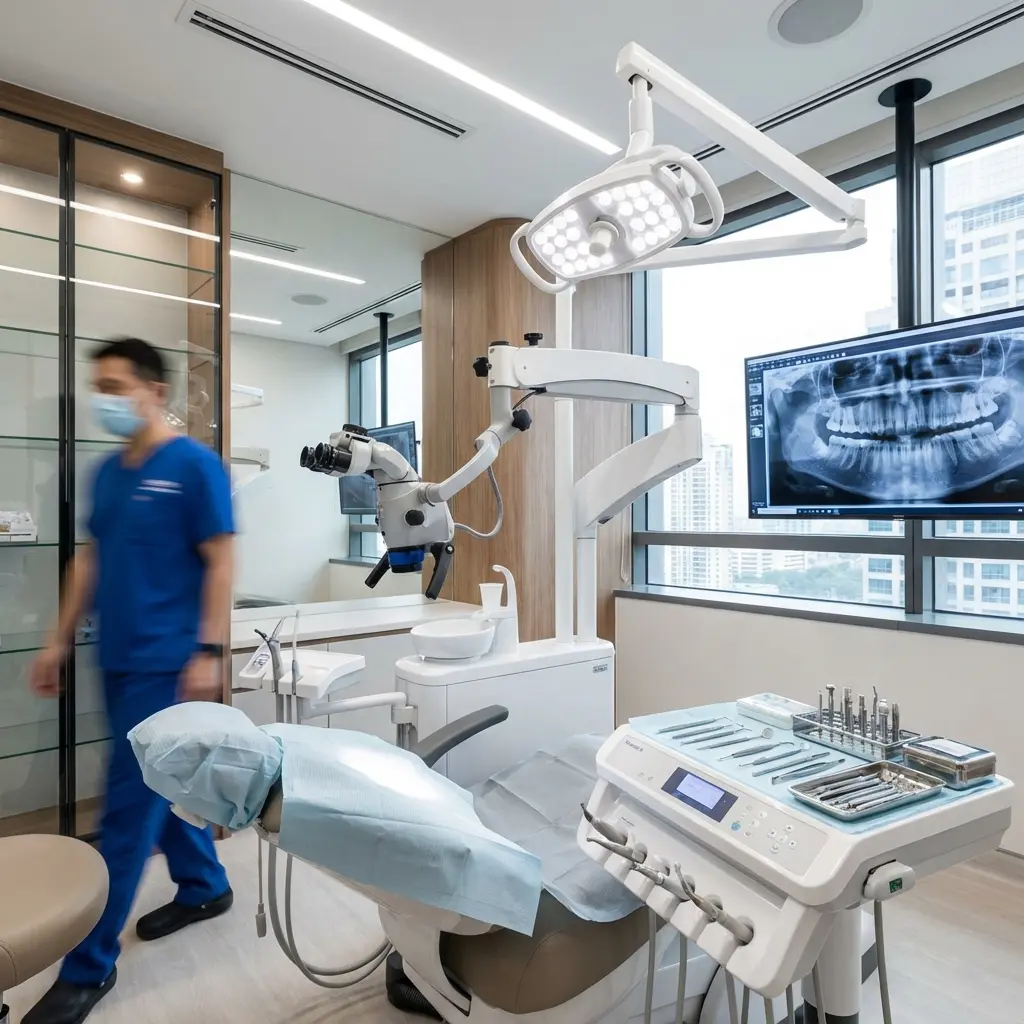
  • ZEISS Extaro microscope for precise implant positioning
  • Bite guard mandatory in the first 6 months for both concepts

  • Scientific qualifications: M.Sc. in Lasers in Dentistry (RWTH Aachen 2021) — Second graduate in Poland, the youngest, with distinction. LA&HA Lecturer (Slovenia 2019, 2023; Poland Keynote 2022). Oral Surgery Academy Curriculum. More on the biography page.


    Mikrostomart Clinic — All-on-X Experience


    Mikrostomart Clinic in central Opole has been led since 2016. We have placed over 1,250 implants and provided care to over 6,000 patients. Current treatment statistics are visible live on our homepage from our Practice Management System.


    Accreditations (more details on the accreditations page):


  • PTE — Polish Society of Endodontology
  • ESE — European Society of Endodontology
  • PTSL — Polish Society of Stomatological Laser Therapy
  • LA&HA — Laser and Health Academy (Slovenia) — Lecturer
  • Oral Surgery Academy — Curriculum in complex surgery

  • Treatment Timeline — Brief Overview


    The detailed treatment timeline including Osstell ISQ measurement, immediate loading criteria, and PRF application is fully described in the article on Immediate Loading Dental Implants. For All-on-4 and All-on-6, the same principles apply:


  • Day 1: CBCT diagnostics + digital mock-up + treatment plan
  • Day 2 or 3: Surgery (60-90 min All-on-4, 120-180 min All-on-6) + temporary bridge
  • Day 4-5: Wound check and suture removal
  • 3-4 months later: Second visit to Opole — final bridge in all-ceramic, zirconia, or acrylic on titanium framework

  • Costs in Detail — Comparison Poland vs. UK


    Mikrostomart Opole (2026):


  • All-on-4 with immediate loading: 30,000-40,000 PLN (~£6,000-8,000 / €7,000-9,300)
  • All-on-4 plus 2 (Hybrid): 37,000-47,000 PLN (~£7,400-9,400 / €8,600-11,000)
  • All-on-6 with immediate loading: 45,000-55,000 PLN (~£9,000-11,000 / €10,500-12,800)

  • Comparison UK private dentistry:


  • All-on-4: typically £15,000-£25,000
  • All-on-6: typically £22,000-£35,000
  • Cost savings Poland vs. UK: 50-70% with identical Premium implants

  • Exact pricing for your situation is provided after the CBCT initial consultation with a written quote in English suitable for private insurance. Current price range on the pricing page. Information on reimbursement through insurance and EU Cross-Border Healthcare Directive.


    Travel and Logistics


    Both concepts require 2 visits to Opole:


  • Visit 1 (3-5 days): CBCT, surgery, temporary bridge, follow-up
  • Visit 2 (1-2 days, after 3-4 months): final bridge

  • Travel: London (~2h flight to Wrocław), Manchester (2.5h), Dublin (2.5h direct), Edinburgh seasonal. Detailed travel information on the Information for Visiting Patients page.


    Frequently Asked Questions (FAQ)


    Which concept is more durable — All-on-4 or All-on-6?


    With correctly indicated application, both concepts are comparably durable. Maló's 18-year follow-up (2019) shows an All-on-4 success rate of 94.8% implant survival — values that are marginally higher for All-on-6, but statistically practically converge. More important than implant count are factors like implant quality (Premium brands!), correct indication, and oral hygiene compliance.


    Will the fixed bridge look like a natural jaw?


    Yes. For both All-on-4 and All-on-6, we create individual all-ceramic or zirconia bridges (12-14 teeth per jaw). With digital mock-up, you see the planned result before the surgery and can request adjustments. The natural appearance does not differ.


    Can I later extend from All-on-4 to All-on-6?


    Yes, that's the logic of the "All-on-4 plus 2" concept. We first place All-on-4, and if needed (e.g. after implant loss or additional load), we supplement with two more anterior implants. This must be planned from the start.


    What happens if one implant fails?


    For All-on-6, the bridge can usually continue to function on the remaining 5 implants — you have reserve. For All-on-4, an implant failure is more critical (only 3 instead of 4 remain); usually requires re-implantation. Detailed information on complication management on the Dental Implant Complications page.


    Do I really not need bone grafting for All-on-4?


    In most cases, no. The angled placement of the distal implants (30-45°) allows the implants to be placed in the dense anterior bone, bypassing the maxillary sinus. For extremely severely resorbed jaws, bone grafting may still be necessary — the final decision is made after CBCT evaluation.


    Next Steps — Initial Consultation in Opole


    The decision between All-on-4 and All-on-6 is individual and should be based on a careful clinical assessment. Start with a non-committal initial consultation:


  • Phone and WhatsApp: +48 570 270 470 (Marcin and Elżbieta speak fluent English)
  • Online booking: via our booking page
  • Email: via our contact form

  • Related topics:


  • Dental Implants in Poland — Costs, Quality, Experiences — the main article
  • Immediate Loading Dental Implants — Requirements and Risks — Immediate loading concept in detail
  • Bone Grafting — Methods, Costs, Success Rates — if bone augmentation is needed
  • Implantology — Service Overview
  • Implants in Opole (local geo page in Polish)
  • Warranty and Reimbursement

  • Mikrostomart Opole — All-on-4 and All-on-6 with Premium implants and ZEISS microscope precision. Close to the UK and Ireland.

    All-on-4 vs All-on-6: Which Full Arch Solution Fits You? (Comparison 2026) | Knowledge Base Mikrostomart