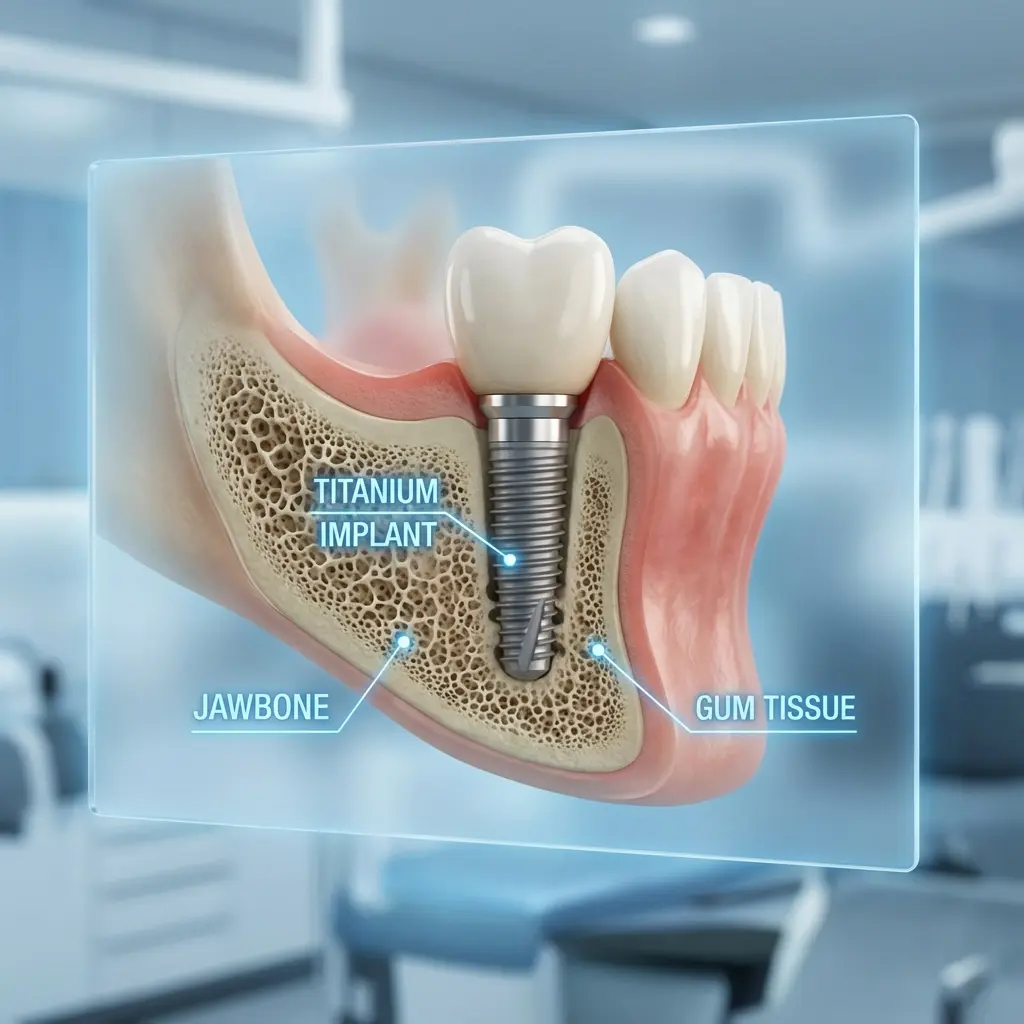
Introduction — What Is Immediate Loading?
The classic dental implant treatment is a two-phase process: the implant is placed, you wait 3-6 months for complete osseointegration (bone integration), then the crown is fitted. During this waiting period, patients often wear a temporary denture or live with a visible gap.
With immediate loading, the implant is fitted with a temporary or final crown within 24-72 hours — you leave the clinic with a fixed dental restoration in place. In selected cases this is not only possible but actually the clinically superior option.
Important: immediate loading ≠ immediate restoration. With immediate restoration, the crown carries no chewing load (occlusally relieved); with true immediate loading, the crown has normal contact with the opposing teeth. Both concepts are part of our treatment range at Mikrostomart Opole.
This article explains when immediate loading is safe, what requirements must be met, and what risks you should know about — based on current scientific evidence and our clinical experience. If you're considering a complete implant treatment in Poland, immediate loading is often crucial for planning your travel.
Requirements — When Immediate Loading Is Possible
The international consensus literature (ITI Treatment Guide, 2019; Esposito et al., Cochrane Review 2013) defines clear minimum conditions for safe immediate loading:
Primary Implant Stability ≥ 35 Ncm
The insertion torque when placing the implant must be at least 35 Newton-centimetres — this measures how firmly anchored the implant is in the bone. Below this value, stability is insufficient for immediate chewing load.
ISQ ≥ 70 (Osstell Measurement)
At Mikrostomart, we use an Osstell Beacon — a device for Resonance Frequency Analysis (RFA). It measures the ISQ value (*Implant Stability Quotient*) on a scale of 1-100. Values ≥70 indicate sufficient primary stability for immediate loading.
This measurement is not an optional extra — it is the scientifically validated method for making intraoperative decisions about immediate loading, rather than relying on the surgeon's "feel".
Bone Quality — Type 1 to 3 (Lekholm-Zarb Classification)
The bone must have sufficient density. Type 1 (very dense, often anterior mandible) and Type 2 (dense with cortical component) are ideal. Type 3 is acceptable with adjusted technique. Type 4 (soft, spongy — typical of the posterior maxilla) is not suitable for immediate loading.
Sufficient Bone Volume
Minimum bone height for a standard implant: 10 mm vertical, 6 mm horizontal. If volume is below this, bone grafting is performed first — immediate loading is then possible only after 4-9 months.
Sterile Surgical Field
No acute infection, no active bone destruction. For immediate placement after tooth extraction, we make the decision intraoperatively after thorough debridement of the socket.
Patient Compliance
You must strictly follow our aftercare instructions — soft diet for 6-8 weeks, no pressure on the implant, careful oral hygiene. Non-compliance is one of the main causes of early implant failures.
When Immediate Loading Is NOT Suitable — Risk Factors
Even when technical parameters (stability, bone) are optimal, medical and lifestyle factors may indicate against immediate loading:
Honest medical history is critical — including pre-existing conditions and medications you may consider irrelevant. We discuss all factors during the initial consultation in Opole.
Two Main Scenarios for Immediate Loading
Scenario A: Immediate Loading in an Extraction Socket
A tooth is extracted, an implant immediately placed, and a temporary crown immediately fitted. Three procedures in one day. When conditions are met, this approach avoids multiple surgeries and shortens treatment time by months.
Critical conditions: socket thoroughly debrided, primary stability ≥35 Ncm in residual bone, PRF augmentation in the gap between implant and socket wall, optional bone substitute material (Bio-Oss®).
Scenario B: Immediate Loading in Previously Healed Bone
The bone is already stable (extraction several months ago, healed socket, or reconstructed bone after grafting). Implant placed, ISQ measured, with values ≥70 immediately fitted with crown.
Advantage of this scenario: more predictable primary stability, clearer indication. We recommend it as a safer alternative for patients who want to avoid the additional risks of immediate implant placement.
All-on-4 and All-on-6 — Immediate Loading for Full Arch
One of the best-known immediate loading concepts is All-on-4 (or All-on-6) — a complete bridge on 4-6 implants with immediate restoration on the day of surgery.
How it works:
Costs at Mikrostomart (2026):
Comparison with UK private dentistry: All-on-4 typically £15,000-£25,000; All-on-6 £22,000-£35,000. Cost savings 50-70% with identical Premium implant brands.
The exact quote for your situation is provided after the CBCT initial consultation. Current price range on the pricing page.
Scientific Evidence — Success Rates
Immediate loading has been extensively researched and documented since the early 2000s. Key data from systematic reviews and long-term studies:
Key lesson from research: The success rate of immediate loading is nearly identical to conventional approach, provided the requirements are met. Poor indication (e.g. ISQ <70, soft bone, smoking) drops the success rate to 80-85%.
Treatment Timeline — Six Steps
Step 1: Initial Consultation + CBCT Diagnostics (Day 1)
3D imaging of the jaw, assessment of bone volume and density, planning of implant position with surgical guide, determination of method (single implant / multi-unit / All-on-4-6).
Step 2: Digital Mock-Up and Patient Approval
We scan your dentition intraorally (3Shape Trios) and show you the planned final restoration on screen. You see the result before the surgery begins — and can request adjustments.
Step 3: Surgery Day (60-90 min single implant, 120-180 min All-on-4)
Step 4: Temporary Crown Within 24-48 Hours
CAD/CAM-fabricated temporary crown (PMMA or composite) is screwed onto the implant. You leave the clinic with a functional dental restoration.
Step 5: 1-2 Weeks Follow-Up
In Opole or remotely via WhatsApp photo consultation. Suture removal (if non-resorbable), wound healing check.
Step 6: Final Crown After 3-4 Months
After completed osseointegration: second visit to Opole, final intraoral scan, individually crafted all-ceramic or zirconia crown. Final result: a natural, fully functional tooth replacement.
Marcin Nowosielski — Immediate Loading Protocol at Mikrostomart
Marcin Nowosielski M.Sc.'s clinical immediate loading protocol is based on evidence-based decision criteria:
Marcin's scientific qualifications:
More details and publications on the About Dentist Marcin Nowosielski M.Sc. page.
Comparison: Immediate Loading vs. Conventional Approach
Treatment Duration
Number of Visits to Opole
Social Acceptance During Healing
Success Rate (Properly Indicated)
Risk with Suboptimal Indication
Costs
Which method is right for you we determine at the CBCT initial consultation in Opole.
Costs — Immediate Loading in Poland
Single implant with immediate loading:
All-on-4 with immediate loading: 30,000-40,000 PLN (~£6,000-8,000, €7,000-9,300)
All-on-6 with immediate loading: 45,000-55,000 PLN (~£9,000-11,000, €10,500-12,800)
Cost savings vs. UK: 50-70% with identical implant brands (Straumann, Nobel Biocare, Astra Tech). We provide a written quote in English suitable for private insurance submission.
More information on reimbursement through health insurance and example calculations.
Travel and Stay
Immediate loading requires a longer first visit (3-5 days), as surgery, temporary placement, and follow-up occur within this period:
Travel to Opole:
Further information on logistics, hotels within walking distance, and language support on the Information for Visiting Patients page.
Mikrostomart Clinic — Experience and Statistics
Mikrostomart Clinic in central Opole has been led since 2016 by Dentist Marcin Nowosielski M.Sc. and his wife Elżbieta Nowosielska. We have placed over 1,250 implants and provided care to over 6,000 patients — a significant portion from the UK, Ireland, Germany, and across Europe.
Current treatment statistics are visible live on our homepage in real-time dashboard — directly from our Practice Management System.
Frequently Asked Questions (FAQ)
Does immediate loading hurt more than conventional approach?
No. The actual procedure is identical — local anaesthesia, optional nitrous oxide sedation. The first 2-3 days after surgery are well-controlled with standard analgesics (ibuprofen 400 mg + paracetamol 500 mg). Subsequently, you should eat soft foods for 6-8 weeks to avoid overloading the newly loaded implant.
What happens if the implant doesn't osseointegrate?
For a failure rate of 2-5% (properly indicated immediate loading), the implant is gently removed, the bone heals, optionally grafted, and after 4-6 months we place a new implant — usually successfully. You are protected by our Treatment Warranty.
Can I eat normally with the immediate crown?
With restrictions. In the first 6-8 weeks, you should prefer soft foods (pasta, cooked vegetables, soft bread, fish, well-cooked meat). Hard foods (nuts, hard carrots, crispy pizza crust) should be avoided. Subsequently, chewing load normalises gradually. Bite guard at night is mandatory.
Will the gap after extraction be visible?
No — that's precisely the advantage of immediate loading. The temporary crown is fitted within 24-48 hours after implantation. You leave Opole already with an aesthetically pleasing, functional dental restoration.
I smoke 5-10 cigarettes a day — can I have immediate loading?
With limitations. For 5-10 cigarettes daily, we discuss individual risk (success rate drops by approximately 5-10%). We strongly recommend complete nicotine abstinence at least 2 weeks before and 8 weeks after implantation. For >10 cigarettes daily, we advise against the immediate loading concept.
Do I really need bone grafting for All-on-4?
Often not. The All-on-4 concept uses angled placement of distal implants (15-30° inclination) — relocating implants to the dense anterior jaw bone, without the need to lift the maxillary sinus. For severely resorbed jaws, additional bone grafting may be necessary — clarified during CBCT initial consultation.
Next Steps — Free Initial Consultation
Immediate loading is an efficient, predictable treatment option for the right patients — provided indication is made carefully based on CBCT diagnostics, ISQ measurement, and thorough medical history. If you're considering implant treatment in Poland and interested in a faster solution, start with a non-committal initial consultation.
Contact options:
Related topics:
Mikrostomart Opole — Immediate loading with scientific indication. Premium implants, ZEISS microscope, Osstell ISQ measurement. Close to the UK and Ireland.