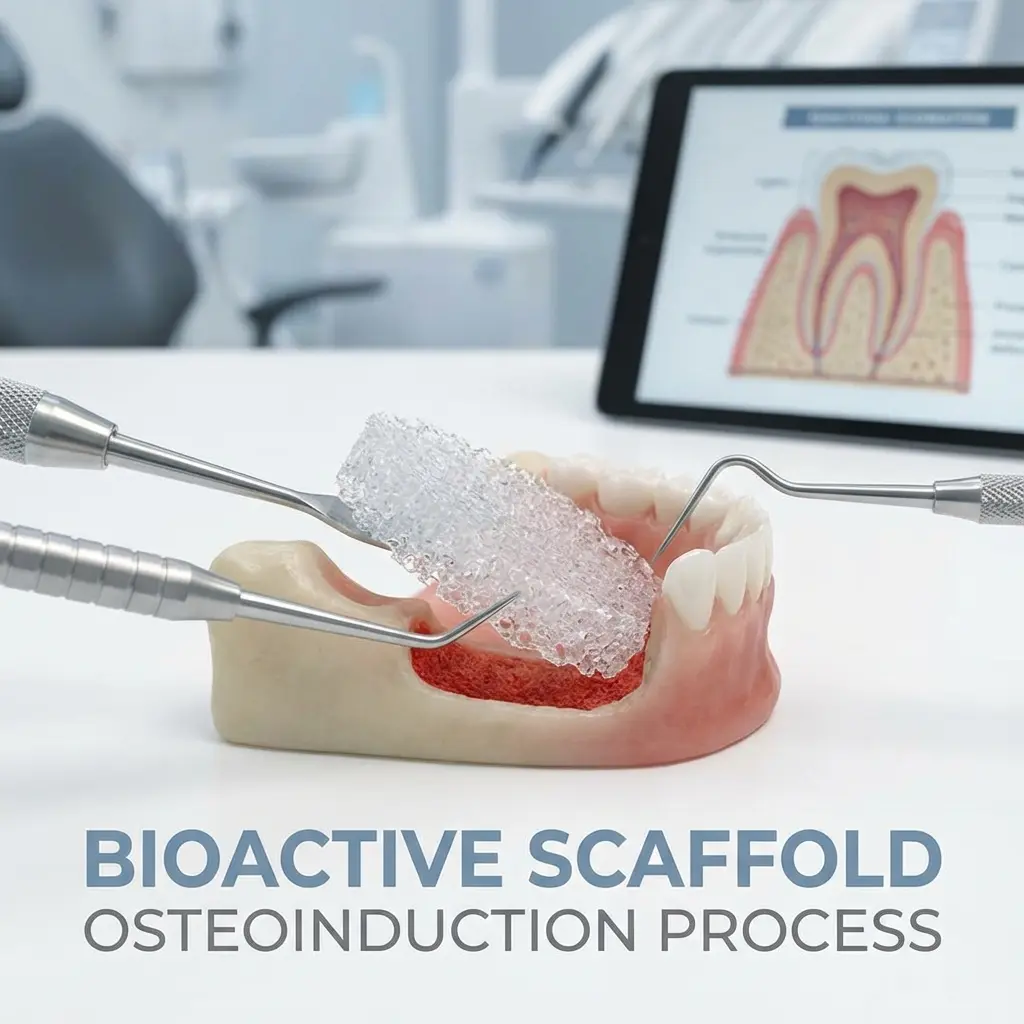
Introduction — When Is Bone Grafting Necessary?
A dental implant requires stable bony anchorage to function reliably. If the jaw bone has atrophied after years of tooth loss, has been weakened by periodontitis (gum disease), or anatomical conditions are unfavourable (e.g. proximity to the maxillary sinus), the available bone volume is often insufficient.
In approximately 30-40% of all implant cases, a concurrent bone graft (also called bone augmentation) is required. The good news: modern techniques and materials such as Bio-Oss® by Geistlich and PRF (Platelet-Rich Fibrin) from your own blood now make predictable treatment possible even in seemingly hopeless cases — with success rates between 90 and 98%.
This article explains the main bone grafting methods, provides a realistic price range for treatment in Poland (Mikrostomart Opole), and shows what scientific research says about long-term prognosis. If you're considering dental implant treatment in Poland, you'll find here all the relevant information about possible preparatory procedures.
Four Main Bone Grafting Methods
The choice of method depends on the extent and location of the bone deficiency. We regularly combine several techniques in a single session.
1. Guided Bone Regeneration (GBR)
GBR is the most commonly used method for moderate horizontal or vertical defects. A bone substitute material (typically Bio-Oss®) is applied to the exposed bone and covered with a resorbable collagen membrane (Bio-Gide®). The membrane prevents soft tissue ingrowth and gives bone-forming cells time (4-9 months) to remodel the graft into stable, vital bone.
Typical indications: local horizontal defects after extractions, peri-implant defects, defect reconstruction before implantation.
2. Sinus Lift (Internal and External)
In a sinus lift, the floor of the maxillary sinus is elevated to create space for an implant in the posterior upper jaw. Two variants:
External sinus lift success rates: 95-98% at 10 years (Wallace & Froum 2003, *Annals of Periodontology*).
3. Autogenous Bone Transplantation
Patient's own bone from the jaw angle or chin region is considered the biological gold standard — no foreign-material reaction, fastest integration. We use autogenous bone primarily for large vertical defects and in combination with Bio-Oss® (so-called "composite graft"). Extraction from the iliac crest (for multiple implants simultaneously) is extremely rare and is generally performed in collaboration with a maxillofacial surgeon in a hospital setting.
4. Immediate Placement with PRF in Extraction Socket
When a tooth is extracted and an implant is to be placed immediately, we fill the gap between the implant and the alveolar wall with PRF from your own blood and Bio-Oss® particles. This technique avoids a separate grafting procedure and reduces total treatment time by 4-6 months. It is not always possible — eligibility is assessed via the CBCT scan during initial consultation.
Premium Materials — What We Use
Lower treatment costs in Poland do not mean cutting corners on materials. On the contrary — we use exclusively the Premium products best documented in international research.
More about our accreditations and scientific activity.
What Does Bone Grafting Cost in Poland?
The cost of a bone graft depends heavily on the extent — a small immediate augmentation in an extraction socket is in a completely different price range than a bilateral external sinus lift with autogenous bone.
Realistic range at Mikrostomart Opole (2026):
Comparison with UK private dentistry: Sinus lift typically £1,500-£3,500; large GBR £2,000-£5,000. Cost savings 40-60% with identical materials.
Exact pricing is provided after your initial consultation in Opole with a written treatment plan suitable for private insurance submission. Current price range on the pricing page.
Treatment Timeline — Five Steps
Step 1: CBCT Diagnostics and Treatment Planning (Day 1)
3D imaging with our CBCT scanner reveals exact bone volume, the position of the maxillary sinus, nerve canal, and adjacent structures. Based on this, we plan the optimal method and discuss alternatives.
Step 2: Surgical Bone Grafting (60-120 min under local anaesthesia)
Sterile preparation, incision, exposure of the bone defect, placement of graft material (Bio-Oss® and optionally autogenous chips), coverage with Bio-Gide® membrane, sutures. If concurrent implant placement: implant inserted in the same session.
Step 3: Healing and Bone Consolidation (4-9 months)
You return to the UK or your home country. During this period, your body remodels the graft into vital bone tissue. Close monitoring is not necessary — for any questions, contact us 24/7 via WhatsApp in English.
Step 4: Implant Placement (after consolidation)
Second procedure: implant placement in the now-stable bone. For immediate augmentation cases (Method 4), this step is skipped — the implant is already in place.
Step 5: Prosthetic Restoration (3-6 months later)
After successful osseointegration: abutment placement + crown made from all-ceramic or zirconia. Final result: a natural-looking, fully functional tooth replacement.
Success Rates — What Research Shows
Scientific literature has documented bone grafting extensively over three decades. The key numbers:
Risk factors that reduce success rates:
At Mikrostomart, we conduct a thorough risk assessment before each bone grafting procedure — even when you travel from the UK. Open communication about pre-existing conditions is critical for success.
Dentist Marcin Nowosielski M.Sc. — Expertise in Bone Surgery and Laser Therapy
Bone grafting is one of Marcin Nowosielski M.Sc.'s clinical specialities, closely linked to laser-assisted implantology.
Relevant scientific and clinical qualifications:
More biographical details and publications on the About Dentist Marcin Nowosielski M.Sc. page.
Mikrostomart Clinic — What We Offer
Mikrostomart Clinic in central Opole has been led since 2016 by Dentist Marcin Nowosielski M.Sc. and his wife Elżbieta Nowosielska (Dental Hygienist). We have performed over 1,250 implants and provided care to over 6,000 patients — a significant portion from the UK, Ireland, Germany, and across Europe.
Current treatment statistics are displayed live on our homepage in a real-time dashboard — directly from our Practice Management System.
Travelling to Opole from the UK and Ireland for Bone Grafting
For the bone grafting procedure itself, 1-2 visits to Opole are sufficient:
Flight times:
Detailed travel information, hotels within walking distance, and language support on the Information for Visiting Patients page.
Reimbursement Through Insurance or EU Directive
For UK Patients (Post-Brexit)
Many UK private health insurance plans (BUPA, AXA, Aviva, Vitality, Cigna) cover bone grafting procedures abroad. We provide a detailed English-language quote and invoice suitable for insurance submission.
For EU Citizens
According to the EU Cross-Border Healthcare Directive 2011/24, you have the right to receive medical care in another EU member state and claim reimbursement from your home country's health insurance.
Step-by-step reimbursement guidance and example calculations on our Warranty and Reimbursement page.
Frequently Asked Questions (FAQ)
How long does the complete treatment with implant take?
From the first day to the finished crown typically takes 9-14 months: bone grafting (1 day) + healing (4-9 months) + implant placement (1 day) + osseointegration (3-6 months) + crown fitting (1-2 days). For immediate augmentation with immediate implant placement, the process is reduced to 6-9 months.
Does the bone graft procedure hurt?
During the procedure no — we work under local anaesthetic (optionally with nitrous oxide sedation for anxious patients). For the first 2-3 days after the procedure, discomfort is mild to moderate and well-controlled with standard analgesics (ibuprofen 400 mg + paracetamol 500 mg). You receive detailed written aftercare instructions in English.
Can I avoid bone grafting — are there alternatives?
In some cases, yes. Alternatives include:
Which option is best for you we clarify during the CBCT initial consultation.
Is Bio-Oss® safe? It comes from bovine bone after all.
Yes, Bio-Oss® is highly safe. The material is processed through a patented procedure at high temperatures into a completely demineralised, protein-free form — all organic components (proteins, DNA, cells) are eliminated. What remains is a pure inorganic bone matrix that serves as an osteoconductive scaffold. Used worldwide since the 1980s, with over 1,000 scientific publications confirming safety and long-term prognosis. For patients with ethical concerns about xenogeneic materials, we offer synthetic alternatives (Cerasorb®).
Might I need multiple bone grafting procedures?
For large, complex defects, a staged approach may be appropriate — e.g. first horizontal GBR, after 6 months sinus lift, after another 6 months implantation. Such cases are rare (about 5-10% of all bone grafts) and are precisely discussed during CBCT planning. In most cases, a single session combined with implantation is sufficient.
What happens if the bone graft is unsuccessful?
For an unsuccess rate of 2-10% (depending on method and risk profile), we carefully remove the graft, treat any inflammation, and plan a second attempt after healing. In the vast majority of cases, a second attempt leads to success. You are protected by our Treatment Warranty for such contingencies.
Next Steps — Free Initial Consultation in Opole
Bone grafting is a predictable, well-planned procedure — provided it is planned based on careful CBCT diagnostics and performed with Premium materials. If you're considering implant treatment in Poland, start with a non-committal initial consultation.
Contact options:
Related topics:
Mikrostomart Opole — Premium bone grafting with scientific foundation. Close to the UK and Ireland.