🍪 Cookies & Privacy

This website uses cookies to provide services in accordance with the Cookie Policy. You can specify the conditions for storing or accessing cookies in your browser.

Back to Knowledge Base

Dental Implant Complications: Peri-Implantitis, Failures — Prevention and Treatment

Dental Implant Complications: Peri-Implantitis, Failures — Prevention and Treatment
2026-05-25

Introduction — Are Dental Implants Safe?


Yes. Dental implants are among the most successful surgical procedures in modern medicine — with success rates between 95 and 99% at 10 years with proper indication and aftercare. For comparison: many purely orthopaedic procedures (hip, knee prosthesis) are in the same range.


But: no medical procedure is 100% complication-free. In 2-5% of patients, complications occur over the years — from harmless, quickly treatable swellings to implant losses. The good news: most complications are predictable, preventable, and well-treatable — when detected early.


This article is an honest, evidence-based explanation of possible complications: what they are, why they arise, how we treat them, and — most importantly — how we prevent them. We believe that informed patients achieve the best clinical outcomes.


If you're considering an implant treatment in Poland or already have an implant and are concerned about complications, you'll find here structured information for an informed decision.


Early vs. Late Failures — The Important Distinction


Complications in implantology are categorised by time of occurrence. This distinction is critical for diagnosis and treatment.


Early Failures (Within 3-6 Months After Placement)


The implant fails during osseointegration — the phase in which it should normally integrate with the bone. Typical causes:


  • Insufficient primary stability during placement (insertion torque <25 Ncm)
  • Excessive load during healing (too early pressure on the temporary)
  • Contamination errors (bacteria during surgery)
  • Patient factors — heavy smoking, uncontrolled diabetes, bisphosphonate therapy
  • Micromotion of the implant exceeding 100 micrometres during bone healing

  • Frequency: approximately 1-3% of all implants. Detection: the implant is loose or painful — we gently remove it, the bone heals (3-4 months), then we place a new implant — usually successfully.


    Late Failures (After Completed Osseointegration)


    The implant was osseointegrated and functional, but complications develop over months to years. Main causes:


  • Peri-implantitis (most common late complication — see next section)
  • Excessive chewing load (bruxism without splint, incorrect occlusion)
  • Bone loss due to periodontitis at neighbouring teeth
  • Mechanical damage (screw fracture, crown loosening)
  • Patient-side factors — smoking, poor oral hygiene, uncontrolled diabetes

  • Frequency: approximately 2-5% of all implants at 5-10 years.


    The Most Common Complications Overview


    Peri-Implant Mucositis (Reversible)


    What it is: Inflammation of the soft tissue around the implant — analogous to gingivitis at natural teeth. Reversible with timely treatment.


  • Symptoms: Bleeding on probing, mild redness, possible swelling
  • Frequency: 30-50% of all implant patients over 5-10 years
  • Treatment: professional cleaning + improved oral hygiene + local chlorhexidine application — fully reversible
  • Relationship to peri-implantitis: Mucositis is the precursor — untreated, it develops into peri-implantitis in 10-20% of cases

  • Peri-Implantitis (Bone Loss)


    What it is: Inflammation with bone loss around the implant — analogous to periodontitis at natural teeth. Not spontaneously reversible without treatment.


  • Symptoms: Bleeding on probing, suppuration, bone loss >2mm on X-ray, pocket depth >5mm
  • Frequency: 5-10% at 10 years (Mombelli et al. 2012, systematic review), up to 20% in risk patients
  • Diagnosis: Probing (BoP = Bleeding on Probing positive, pocket depth), radiographic imaging (vertical bone loss), eventual mobility
  • Treatment: staged — non-surgical → surgical → regenerative → explantation

  • Mechanical Complications — Screw Loosening


    What it is: The screw that fixes the crown or abutment to the implant becomes loose.


  • Frequency: 3-5% at 5 years, more common with single crowns than bridges
  • Causes: incorrect occlusion (teeth touch unevenly), bruxism without splint, mechanical fatigue
  • Symptoms: Crown wobbling, slight mobility
  • Treatment: minimally invasive — remove crown, retighten screw with correct torque (typically 25-35 Ncm), adjust occlusion

  • Implant Fracture (Very Rare)


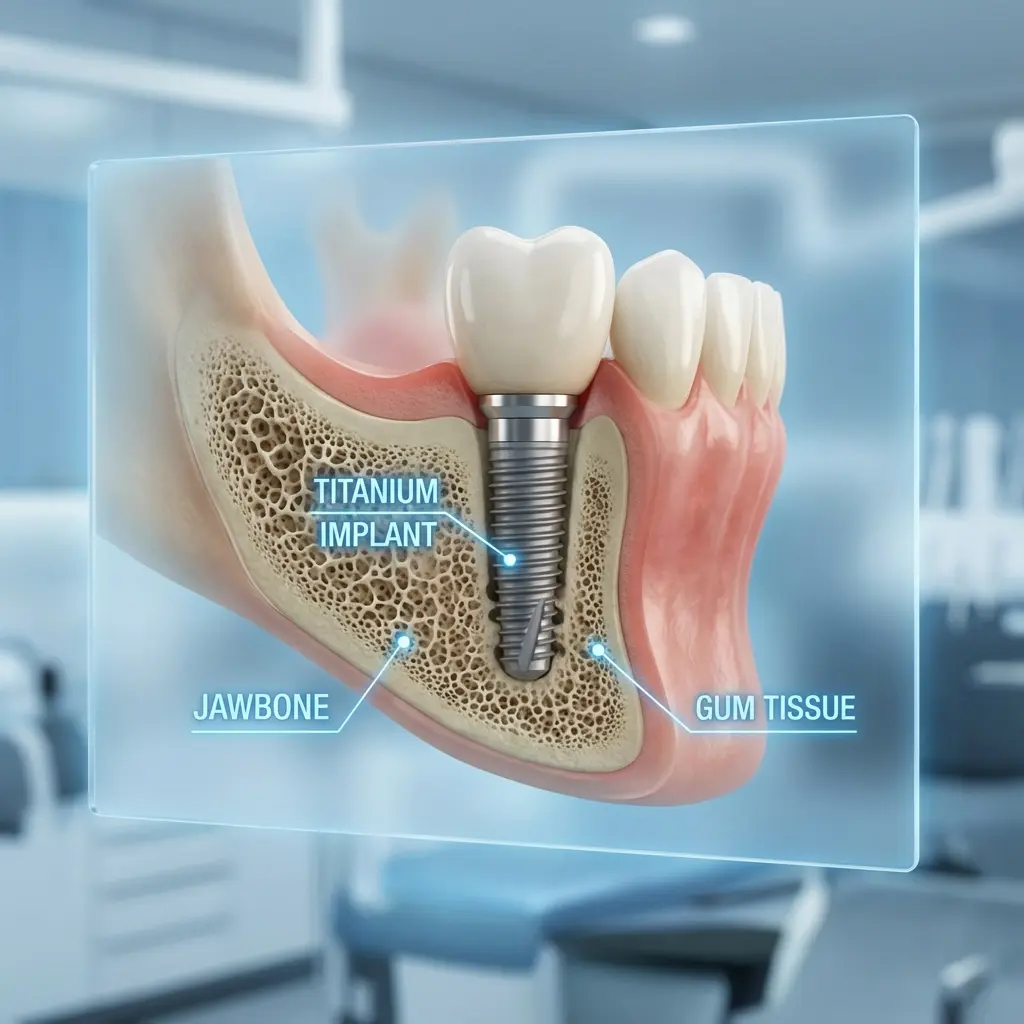
    What it is: Fracture of the titanium implant itself.


  • Frequency: <0.5% — extremely rare, almost always with very narrow implants (3.0mm) under extreme load
  • Causes: Implant too narrow for position, severe bruxism, faulty implant wear
  • Treatment: Explantation + after healing, new implant with larger diameter

  • Progressive Bone Loss Without Inflammation


    What it is: Bone resorption around the implant without classical inflammatory signs.


  • Frequency: 3-7% at 10 years
  • Causes: Overload, thin crestal bone, suboptimal position
  • Treatment: Overload analysis, possibly regenerative therapy

  • Peri-Implantitis — The Detailed Look


    Peri-implantitis is the most important late complication in implantology. Since it can lead to implant loss without treatment, a detailed look is worthwhile.


    Causes — Who Is at Risk?


    The main risk factors are well documented scientifically:


  • Poor oral hygiene — biofilm accumulation at the implant-tissue interface
  • Previous periodontitis — 3-6 fold increased risk (Heitz-Mayfield 2018)
  • Heavy smoking (>10 cigarettes/day) — 3-5 fold increased risk (Strietzel 2007)
  • Uncontrolled diabetes mellitus (HbA1c >7.5) — impaired immune defence
  • Bruxism without bite splint — excessive load weakens peri-implant structures
  • Lack of professional aftercare — no cleaning every 3-6 months
  • Excess cement (with cemented crowns) — residual luting cement triggers inflammation
  • Genetic factors — polymorphisms in IL-1 genes increase risk

  • Symptoms — When to Contact Us


    Early signs (well-treatable):


  • Mild bleeding when brushing at the implant
  • Slight redness or swelling of the gum
  • Altered taste (metallic, bitter)
  • Bad breath from the area

  • Late signs (urgent treatment needed):


  • Palpable pocket depth (you can feel a "pocket" around the implant with your tongue)
  • Pain when chewing
  • Visible gum recession
  • Implant mobility (very late phase — usually implant loss)

  • Diagnosis at Mikrostomart


  • Clinical examination: Probing (pocket depth, bleeding on probing), mobility test, inspection
  • Radiographic diagnostics: bitewing or CBCT 3D imaging — quantifying bone loss
  • Microbiological diagnostics (in complex cases): identification of pathogenic bacteria

  • Treatment Stages — Marcin's Protocol


    Stage 1 — Non-surgical therapy (for early peri-implantitis):


  • Mechanical cleaning with special implant curettes (not steel, to protect titanium surface)
  • Er:YAG laser decontamination (Marcin's LA&HA specialty area) — removes biofilm + decontaminates implant surface
  • Photodynamic therapy (PDT) — adjuvant
  • Antibacterial rinsing (chlorhexidine)
  • Follow-up after 6-8 weeks — if improvement, transition to maintenance therapy

  • Stage 2 — Surgical therapy (for advanced peri-implantitis):


  • Flap surgery under microscope guidance (ZEISS Extaro)
  • Granulation tissue removal
  • Implant surface decontamination (Er:YAG laser)
  • Regenerative augmentation with Bio-Oss® + Bio-Gide® for resorbed bone
  • Closure + 3-6 months healing phase

  • Stage 3 — Implant removal (last resort, when preservation is not possible):


  • Gentle explantation
  • Bone augmentation over 4-6 months (see Bone Grafting)
  • After healing: new implant — re-implantation success rates 85-90%

  • Prevention — The Most Important Chapter


    The best treatment is prevention. With proper aftercare, peri-implantitis is avoidable in most cases. The most important measures:


    Professional Aftercare Every 3-6 Months


    At Mikrostomart or with your local dentist (on our recommendation). Implant aftercare includes:


  • Professional cleaning with implant-specific instruments
  • Probing (BoP, pocket depth) — early warning system
  • Radiographic check once annually (bitewing or peri-implant)
  • Adjustment of home oral hygiene
  • If needed: additional decontamination

  • Optimal Home Oral Hygiene


  • Sonic toothbrush (Sonicare or equivalent) 2x daily
  • Interdental brushes for implants (in every interproximal space)
  • Water flosser (Waterpik) — removes plaque in deep areas
  • Antibacterial mouthwash with chlorhexidine short-term during phases of increased risk
  • Tongue cleaner — reduces total bacterial load

  • Lifestyle Optimisation


  • Reduce or quit smoking — the most important single factor
  • Optimise diabetes control (HbA1c <7.0)
  • Wear bite guard for grinding or pressing (at night mandatory after All-on-X restoration)
  • Healthy nutrition — Vitamin D, calcium, antioxidant foods

  • What If Complications Occur?


    We are available 24/7 via WhatsApp and phone (Marcin and Elżbieta speak fluent English). For urgent cases, we organise initial care — either in Opole with short travel or in cooperation with an implantologist near your home in the UK.


    Our treatment warranty covers structural implant problems during the warranty period. Details on the Warranty and Reimbursement page.


    When to Contact Mikrostomart Immediately


    Immediate-contact indications:


  • Severe pain at the implant (more than 7-10 days after surgery)
  • Visible mobility of the implant or crown
  • Purulent secretion from the implant area
  • Sudden swelling with fever
  • Loss of crown or screw

  • For these symptoms, contact us on the same day — early treatment prevents implant loss in most cases.


    Marcin Nowosielski — Complication Management


    Dr Marcin Nowosielski's complication management is based on three pillars:


  • Prevention through scientific indication — we indicate conservatively, decline patients with too high risk or prepare them systematically
  • Early detection through structured aftercare — all patients receive an individual recall programme
  • Evidence-based treatment — Er:YAG laser decontamination, regenerative surgery with Bio-Oss®/Bio-Gide®, combined protocols

  • Scientific qualifications:


  • M.Sc. in Lasers in Dentistry — RWTH Aachen University (2021), second graduate in Poland, with distinction. Master's thesis focus: laser-assisted peri-implantitis therapy.
  • LA&HA Lecturer — Presentations on peri-implantitis treatment with lasers (Slovenia 2019, 2023; Poland Keynote 2022)
  • 4 scientific publications in *Magazyn Stomatologiczny*
  • ESE and PTE memberships — strict adherence to European Society of Endodontology Quality Guidelines

  • More biographical details and publications on the About Dr Marcin Nowosielski page and the accreditations page.


    Mikrostomart Clinic — Experience and Statistics


    Mikrostomart Clinic in central Opole has been led since 2016. We have placed over 1,250 implants and provided care to over 6,000 patients. Current daily treatment statistics are visible live on our homepage from our Practice Management System.


    Our peri-implantitis statistics are significantly below the literature average (5-10%) — result of conservative indication, Premium materials, and structured aftercare.


    Frequently Asked Questions (FAQ)


    How likely is it that my implant will have problems?


    With properly indicated treatment and good aftercare: 2-5% probability for late complications within 10 years. For risk patients (heavy smokers, uncontrolled diabetes, previous periodontitis): up to 10-20%. You can actively reduce your risk through professional aftercare every 3-6 months and good oral hygiene.


    What is the difference between peri-implantitis and periodontitis?


    The mechanisms are very similar (bacterial inflammation with bone loss), but peri-implantitis often progresses more aggressively — the implant-bone interface is more vulnerable than the natural periodontium. Treatment options differ in part, as the implant has no periodontal ligament.


    If I have an implant placed in Poland and later develop problems — who treats me?


    We remain your contact point. For complications, we offer 24/7 consultation via WhatsApp/phone in English. For urgent procedures, we organise either a short-term appointment in Opole (2 hours flight from London) or refer you to an implantologist near your home in the UK. Our Treatment Warranty applies long-term.


    Can I completely prevent peri-implantitis?


    Not to 100% — even with perfect aftercare, complications can occur in rare cases. But you can reduce your risk by 70-80% through: regular professional aftercare, excellent oral hygiene, smoking cessation, well-controlled diabetes, bite guard for grinding.


    How long does an implant typically last?


    With good care and no complications: 20-30+ years — many patients have their implants for life. The crown on the implant typically lasts 15-20 years and can be renewed if needed, without changing the implant.


    What happens if an implant is lost despite all efforts?


    Re-implantation is usually possible after: gentle explantation, 4-6 months bone healing (eventually with bone grafting), new implantation. Re-implantation success rate: 85-90%. We discuss this openly with you if the case occurs.


    Next Steps — Consultation in Opole


    If you're planning implant treatment, it's important to understand complications before they arise. At the initial consultation in Opole we discuss:


  • Your individual risk factors
  • Suitable treatment options (single implant, All-on-4 vs All-on-6, immediate loading)
  • Necessary preparation (e.g. periodontitis treatment, diabetes adjustment)
  • Personalised aftercare programme
  • Warranty and insurance details

  • Contact options:


  • Phone and WhatsApp: +48 570 270 470 (Marcin and Elżbieta speak fluent English)
  • Online booking: via our booking page
  • Email: via our contact form

  • Related topics in the implant cluster:


  • Dental Implants in Poland — Costs, Quality, Experiences — the main article
  • Bone Grafting — Methods, Costs, Success Rates
  • Immediate Loading — Requirements and Risks
  • All-on-4 vs All-on-6 Comparison
  • Implantology — Service Overview
  • Implants in Opole (local geo page in Polish)

  • Mikrostomart Opole — Honest education, evidence-based treatment, long-term care. Close to the UK and Ireland.